
Complex Spine Disorders
Complex spine disorders involve multiple structural problems affecting the spine at the same time, often causing chronic pain, nerve compression, weakness, mobility limitations, and reduced quality of life. These conditions may develop from advanced degeneration, spinal deformity, instability, previous spine surgery, trauma, or a combination of factors that make diagnosis and treatment more complex than routine spine conditions.
At Capital Spine & Pain Institute, Dr. Avery L. Buchholz specializes in diagnosing and treating complex spine disorders with personalized care, helping patients find lasting relief and restore function.

Board Certified
Neurosurgeon

15+ Years
Experience

5000+
Procedures Performed
Get In Touch
Contact us today to schedule your consultation and take the first step toward relief.
This form is intended for scheduling purposes only and is not a HIPAA-compliant form. Please avoid sharing any sensitive medical information. By submitting this form, you agree to be contacted regarding your inquiry.
What is a complex spine disorder?
Most spine problems have a clear cause and a clear fix. Complex spine disorders don't.
We use that term when multiple structural problems exist at the same time—degeneration across several disc levels, a deformity that's been slowly progressing, nerve compression that isn't confined to one spot, or a prior surgery that failed and left things worse. Each problem compounds the others. Symptoms shift. Standard protocols don't hold up.
These cases need more than a routine consultation. They need a surgeon who will review the imaging, read every prior operative report, and develop a plan that accounts for everything going on — not just the most obvious finding.
Dr. Buchholz trained specifically in complex and revision spine surgery. He reads every scan himself and won't recommend an operation until conservative options have been genuinely exhausted.

30 Minutes

Same Day Procedure

General Anesthesia

2-6 Weeks Recovery
Frequently seen signs
Symptoms vary depending on which spinal levels are involved and how many structural problems are present. What makes complex cases distinctive is that symptoms often don't follow a clear pattern — they shift, affect multiple areas at once, and don't fully respond to standard treatment.
Chronic neck or back pain
Persistent pain that doesn't respond to standard care
Radiating pain
Pain that travels into the arms or legs
Trouble walking or staying balanced
Difficulty with gait, stability, or coordination
Progressive muscle weakness
Weakness that gets worse over weeks or months
Numbness or tingling
In the hands, feet, or along the limbs
Pain after prior spine surgery
Symptoms that returned following a previous operation
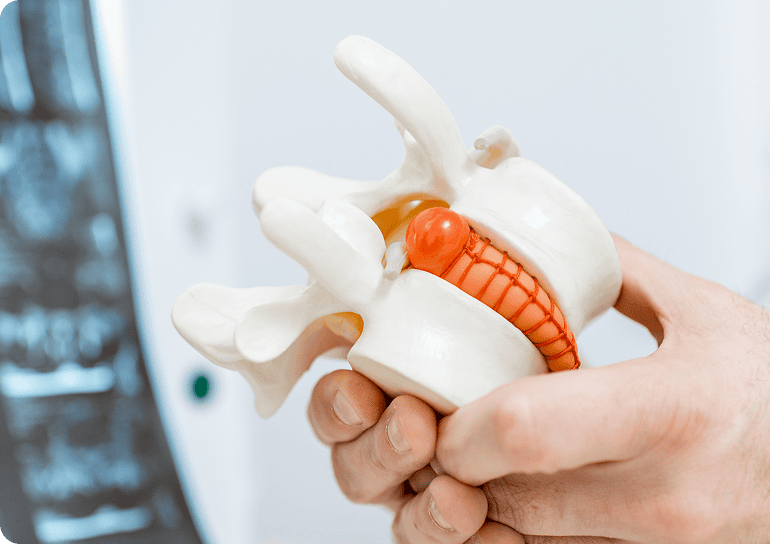
Common Causes and Types of Complex Spine Conditions
Neck pain and headaches rarely exist in isolation. These cervical spine disorders are frequently the structural foundation underneath the headache pattern.

Complex spinal conditions
Complex spine cases rarely involve just one diagnosis. These are the conditions we see most often — and they tend to show up together, each making the others harder to manage.
Multi-Level Disc Degeneration
When degeneration spans three, four, or more levels, the spine loses height and load-bearing capacity at multiple points. Treating any one level in isolation doesn't address the others—which is why these cases need a coordinated plan, not a piecemeal approach.
Spine deformity treatment
When a scoliotic or kyphotic deformity starts compressing nerve roots or significantly altering the patient's center of gravity, surgical correction may be the only way to prevent ongoing neurological deterioration.
Failed Prior Spine Surgery
Revision surgery is technically more demanding than the original procedure. Scar tissue, altered anatomy, and existing hardware all complicate access. Dr. Buchholz evaluates whether the first operation was incomplete, whether hardware has shifted, or whether an adjacent level has broken down in the years since.
Spinal Instability
When vertebrae can't maintain their position under normal load, the spine shifts with movement. This causes unpredictable pain and progressively irritates nerve roots. Instability can follow disc collapse, fracture, or ligament failure—and usually requires stabilization surgery when it's far enough along.
Multi-Level Stenosis
Canal narrowing confined to one level responds reasonably well to decompression. When it spans multiple segments simultaneously, symptoms travel up and down both legs, and the surgical or non-surgical plan has to account for all of them—not just the worst-looking level of imaging.
How It Develops

Initial Disc or Joint Damage
One disc degenerates or a facet joint starts to wear. At first, the symptoms are manageable—occasional stiffness, mild pain with activity. Many patients treat it conservatively for years.

Adjacent Levels Compensate
The discs and joints above and below the damaged segment start absorbing the extra mechanical load. Over time, they begin to break down too. What started at one level is now affecting two or three.

Nerve Compression Sets In
As disc height drops and bone spurs form, the spinal canal narrows. Nerve roots get squeezed. Pain stops staying in the back — it starts traveling down the arm or into the leg. Weakness and numbness follow.

Multi-Level Complexity
Several levels are involved simultaneously. A prior surgery may have helped temporarily, but didn't fully resolve things. Pain is constant, not just positional. At this stage, standard approaches aren't adequate—the full picture needs to be evaluated and treated as a system.
Getting Answers

How We Diagnose Complex Spine Disorders
A scan alone doesn't explain a complex spine case. Imaging shows structure — it doesn't show the full history of what's been tried, what failed, or how symptoms have evolved.
Dr. Buchholz starts by reviewing all prior records: previous operative reports, physical therapy notes, imaging from other facilities, and prior injection history. Then a full neurological examination—strength, sensation, reflexes, balance—was documented at each affected level. He reads every imaging study personally. His recommendations are based on the complete picture, not just what's most visible on the most recent scan.
X-Rays
Shows alignment, disc height, vertebral slippage, and deformity curves. First step.
MRI
Nerve compression, disc pathology, soft tissue detail across multiple levels.
CT Scan
Detailed bone anatomy. Critical when prior hardware is present, or surgery is being planned.
Alignment Studies
Full-length spine X-rays to assess global balance and deformity from top to bottom.
When Should You See a Complex Spine Surgeon?
General spine care handles most patients well. But there's a subset of cases where the standard referral path — primary care, then orthopedics, maybe a pain management injection — isn't enough. If you recognize yourself in the list below, the next step is a proper evaluation by a specialist who handles complex spine cases specifically.
⚠️ Signs That Need Specialist Attention
Pain that hasn't improved after months of conservative treatment
A prior spine operation that didn't fix your symptoms—or made them worse
Weakness, numbness, or balance problems that keep getting worse
A diagnosis involving multiple spinal levels or overlapping conditions
A spinal deformity that is progressing and causing nerve symptoms
Told your case is "too complex" for a standard referral
Imaging showing instability, significant curve, or multi-level pathology
🚨 Emergency Warning
Go to the ER immediately if you lose bladder or bowel control with back or leg pain. This is a spinal emergency—don't wait.
Not every one of these patients ends up needing surgery. Some do well with an adjusted non-surgical plan once a proper diagnosis is in place. But they all need someone who will actually look at the full picture—not just the most recent MRI slice.
Treatment for complex spine conditions
Treatment starts with the least invasive option that could realistically work for your specific presentation and advances from there only if it doesn't.
A significant number of complex spine patients stabilize and improve without surgery. The key is having the right non-surgical plan, not just repeating what hasn't worked before.
When surgery is warranted, it should address the actual structural problems—not the easiest problem on the imaging. Dr. Buchholz operates at multiple levels when the anatomy requires it and uses minimally invasive techniques wherever they're appropriate for the case.
Treatment for Complex Spine Conditions
Conservative Care Foundation
Anti-inflammatory medication, activity modification, and structured rest address the acute component. For many complex cases, this isn't about avoiding surgery permanently — it's about reducing inflammation enough that a proper assessment can happen and rehabilitation can take hold.
Directed Physical Therapy
Generic PT programs often fail complex spine patients because they're designed for straightforward presentations. We work with therapists experienced in multi-level pathology—focused on stabilizing supporting musculature, improving load distribution, and building the specific mobility patterns each patient is losing.
Targeted Injections
Epidural steroids, selective nerve root blocks, and facet joint injections can significantly reduce pain at specific levels. In complex cases, they serve a dual purpose: therapeutic relief and diagnostic confirmation—helping identify which levels are actually driving symptoms.
Bracing & Load Management
External bracing is used selectively — most often in progressive deformity cases or significant instability where activity modification alone isn't controlling symptoms. It's a bridge, not a long-term solution, and always combined with a rehabilitation component.
Surgical Treatment
Spinal Decompression
Removal of the tissue pressing on the neural elements—disc material, thickened ligament, or bone spur. In complex cases, this is often done across multiple segments in the same procedure, requiring careful planning to avoid destabilizing the spine in the process.
Spine Reconstruction Surgery
For cases where instability or deformity has progressed beyond what decompression alone can address. Complex spinal reconstruction surgery restores alignment across multiple vertebral levels using bone graft and instrumentation, stabilizing the spine in the corrected position so it can hold over time.
Revision Spine Surgery
Operating on a spine that has already been surgically altered is significantly more complex than a primary procedure. Scar tissue changes the anatomy. Hardware occupies space. Prior decompression may have left instability behind. Dr. Buchholz reviews all prior operative records and imaging before any revision plan is developed.
Spinal Deformity Correction
Progressive scoliosis or kyphosis causing nerve compression or significant functional loss requires surgical realignment. Complex scoliosis surgery and spine deformity treatment at this level fall under advanced treatment for spinal deformities—the goal is to reduce the curve, decompress the affected nerve roots, and restore the spine's balance so that the correction remains stable over the patient's lifetime.
Why Choose Capital Spine & Pain Institute

Fellowship Training in Complex Spine
Not an add-on to a general spine practice. Dr. Buchholz pursued fellowship training specifically in complex and revision spine surgery because these cases demand a different level of preparation.
Board-Certified Neurosurgeon
Over 15 years and more than 5,000 procedures. You receive specialist-level evaluation from your first appointment—not a referral to someone who handles complex cases occasionally.
Every Scan Reviewed Personally
Dr. Buchholz reads every imaging study himself before making any recommendation. No delegated reads. The person evaluating your imaging is the same person who will operate, if it comes to that.
Minimally Invasive When Appropriate
Minimally invasive surgery isn't always the right call. When it is appropriate — based on anatomy, pathology, and what needs to be corrected — that's the approach used. When it isn't, you'll be told why.
Individual Treatment Plans
There is no template for complex spine cases. Your plan is built from your history, your imaging, your prior treatments, and your goals — not from a protocol designed for straightforward presentations.
GET IN TOUCH
Contact us today to schedule your consultation and take the first step toward relief.
What to expect week by week
Recovery varies, but here's how most patients progress.
Same Day
Go home. Rest.
Procedure done. Mild soreness at the injection site is normal. Skip driving — you'll need a ride.
24–48 Hours
Soreness fades.
Site soreness clears in a day or two. Some patients notice early pain improvement starting here.
1 Week
You should feel a difference.
Most patients see a meaningful reduction in neck and arm pain as the steroid reaches full effect.
Weeks–Months
Continued improvement.
Relief can last weeks to months. A second injection or PT can extend it further if needed.

Expert Spine Surgeon
Dr. Avery L. Buchholz is a board-certified neurosurgeon with fellowship training in complex spine surgery. With over 15 years of experience and 5,000+ procedures performed, he specializes in both minimally invasive and complex surgical techniques.
His expertise spans the full spectrum of spine care, from non-surgical interventions to advanced reconstructive procedures, always prioritizing patient safety and optimal outcomes.
Frequently Asked Questions
Get answers to common questions about our practice and procedures
What is a complex spine disorder?
Multiple spinal problems happening at once—like degeneration, instability, or a failed surgery—where standard treatment simply doesn't cut it.
When is complex spine surgery necessary?
When nothing conservative has worked after months of trying, or nerve symptoms keep getting worse.
How long is the recovery after complex spinal surgery?
Desk work — around four to six weeks. Physical labor — three to six months.
Can complex spine disorders be treated without surgery?
Quite often, yes. Injections, therapy, and activity adjustments help a lot of patients avoid the operating table entirely.
When is complex spine surgery needed?
When a previous surgery didn't hold, conservative options are done, or nerve damage is moving fast.
Is complex scoliosis surgery right for my condition?
That depends on how far the curve has progressed and whether it's pressing on nerves—something only a proper evaluation can answer.
What are the options for advanced treatment for spinal deformities?
Earlier stages — bracing and injections. More advanced cases — reconstruction or multi-level fusion.
What makes Dr. Buchholz different from other spine surgeons?
He went through fellowship training specifically for complex spine cases, looks at every scan himself, and has done 5,000+ procedures. Every patient in Falls Church, Alexandria, and Richmond gets a plan built around their actual case.
Our Locations
Serving patients across VA
Falls Church, VA
431 Park Ave, Falls Church, VA 22046
Open
Get In Touch
Contact us today to schedule your consultation and take the first step toward relief.

Address
6244 Little River Turnpike, Suite 101
Alexandria, VA 22312

Phone
FAX
(571) 250-5150


Office Hours
Monday - Saturday: 9:00 AM - 6:00 PM
Sunday: Closed
This form is intended for scheduling purposes only and is not a HIPAA-compliant form. Please avoid sharing any sensitive medical information.
By submitting this form, you agree to be contacted regarding your inquiry.
Follow Us