
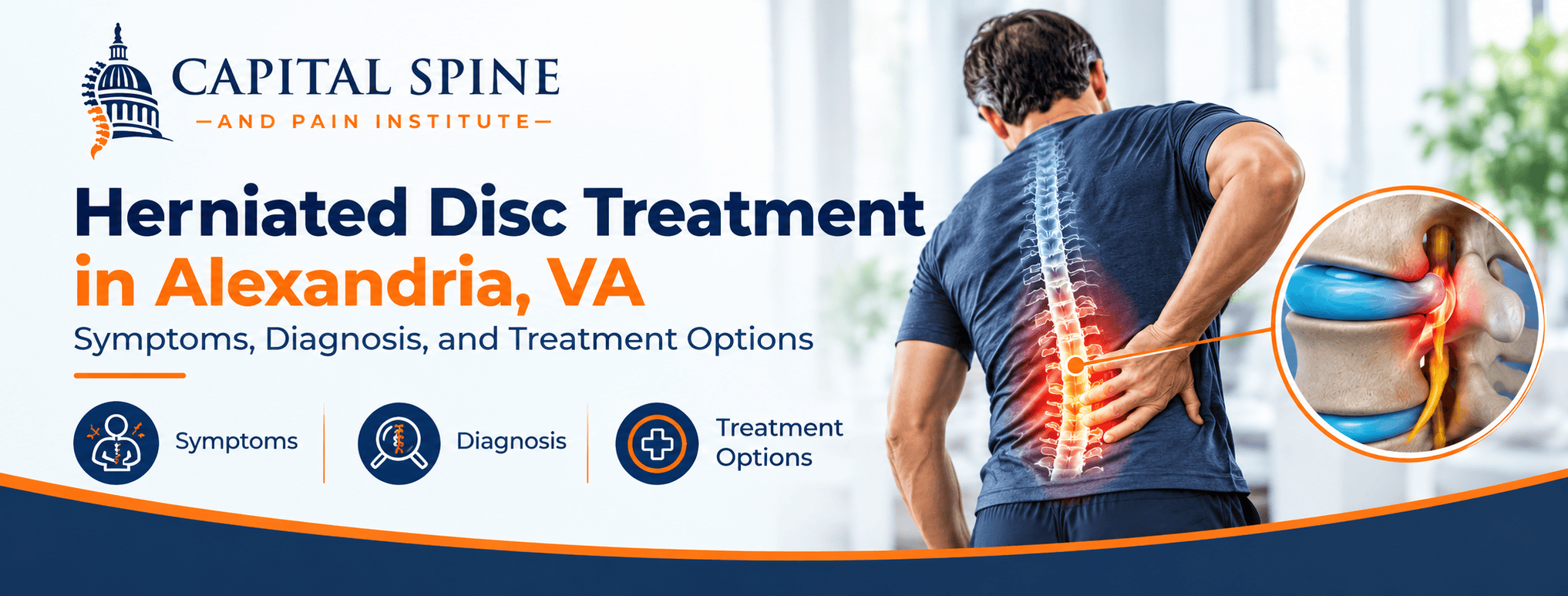
You bend down to pick something up, and a few days later there's a burning line of pain running down your leg. Or your neck gets stiff, and your hand starts tingling. Plenty of people brush this off for weeks. Often, a herniated disc is behind it.
The good news: herniated disc treatment in Alexandria, VA usually begins without surgery. Think activity changes, physical therapy, medication, and sometimes injections. Surgery comes into the picture only when pain is disabling or a nerve is getting worse. At Capital Spine & Pain Institute, the first job is working out what's really causing your symptoms. You can also read our overview of herniated disc symptoms and treatment options.
What Is a Herniated Disc?
A herniated disc is a spinal disc whose soft center has pushed through the tougher outer layer. If that material touches a nearby nerve, it can irritate it.
Discs sit between the bones of your spine like small cushions. When one weakens, the inner material can press on a nerve root, which doctors call nerve root compression.
- Lumbar disc herniation is in the lower back. Pain often shows up in the buttock or leg. See our page on lower back pain treatment.
- Cervical disc herniation is in the neck. Pain often reaches the shoulder or arm. See our page on cervical spine and neck pain treatment.
Age-related wear and physical strain are common causes. And here's something that surprises people: some herniated discs cause no symptoms at all.
What Are the Common Symptoms of a Herniated Disc?
It depends on which disc is involved. Here's what people often report:
- Lower back or neck pain that won't go away
- Pain running into an arm or leg
- Tingling or numbness
- Weak muscles
- Pain that gets worse when you move a certain way or sit too long
Leg pain that starts in the lower back is called sciatica. A herniated disc can cause it, but so can other problems, which is why an exam matters.
How Is a Herniated Disc Diagnosed?
A herniated disc specialist starts by listening, then examines you. Expect some of the following:
- Your history and a physical exam
- A neurological check of strength, reflexes, and feeling
- An MRI, when it makes sense for your case. An MRI for herniated disc diagnosis shows discs and nerves clearly.
- Other tests, if something else might be causing the pain
A scan alone doesn't settle it. Plenty of pain-free people have disc changes on imaging, so the results must fit your symptoms and exam.
What Are the Treatment Options for a Herniated Disc?
No single plan works for everyone. Your doctor will weigh your symptoms, nerve involvement, general health, and what you've already tried.
Non-Surgical Treatment
Most people begin here. Conservative spine treatment can include changing what you do day to day, medication where appropriate, and guided rehab. Physical therapy for herniated discs usually works on movement and core strength.
Epidural Steroid Injections
The doctor places anti-inflammatory medicine near the irritated nerve. It may ease some nerve-related pain. Results differ from person to person, and the injection doesn't fix the disc itself.
Minimally Invasive Spine Surgery
If pain stays disabling even after proper conservative care, or a neurological problem shows up, surgery may be discussed. Minimally invasive spine surgery in Alexandria, VA uses smaller incisions. Some people with a lumbar disc problem may qualify for minimally invasive lumbar disc treatment. It's not the right choice for every herniated disc.
Microdiscectomy
In selected patients, a surgeon uses a microscope and a small incision to remove the piece of disc pressing on a nerve.
When Should You See a Herniated Disc Specialist in Alexandria, VA?
Book a visit if your pain lingers or returns, spreads into an arm or leg, comes with numbness or weakness, or disrupts work and sleep.
Some symptoms need emergency care right away: new trouble controlling your bowels or bladder, numbness around the groin or saddle area, or weakness that's getting worse fast.
Where Can You Get Herniated Disc Treatment in Alexandria, VA?
Capital Spine & Pain Institute offers Alexandria VA spine care, from non-surgical options to minimally invasive surgery. Browse the spine conditions treated by our specialists.
- Address: 6244 Little River Turnpike, Suite 101, Alexandria, VA 22312
- Phone: (571) 399-6340
- Website: https://capitalspineinstitute.com/
Frequently Asked Questions
What is the best treatment for a herniated disc in Alexandria, VA?
There isn't one. Most people start with activity changes, physical therapy, and medication, then move to injections or procedures if symptoms hang on. A herniated disc doctor in Alexandria, VA can suggest a plan after reviewing your exam and imaging.
Can a herniated disc heal without surgery?
Often, yes. Many people improve with non-surgical care, and the disc material can sometimes shrink over time. Results depend on the person and how much a nerve is involved.
How do I know if my herniated disc is pressing on a nerve?
Pain, tingling, numbness, or weakness that follows a line down one arm or leg is a clue, but it isn't proof. An exam, and an MRI when appropriate, is how doctors confirm it.
When is surgery necessary for a herniated disc?
Usually when symptoms are disabling and haven't improved with proper conservative care, or when nerve problems like worsening weakness appear. Most people don't start with surgery.
How long does it take to recover from a herniated disc?
Herniated disc recovery time varies a lot. Some people feel better within weeks of conservative care. Others need more time or a procedure. Your doctor can give you a realistic timeline.
Find Herniated Disc Treatment in Alexandria, VA
If your back, neck, arm, or leg symptoms aren't getting better, getting checked is a sensible next step. Call Capital Spine & Pain Institute at (571) 399-6340, or schedule a spine care consultation at our Alexandria office.