
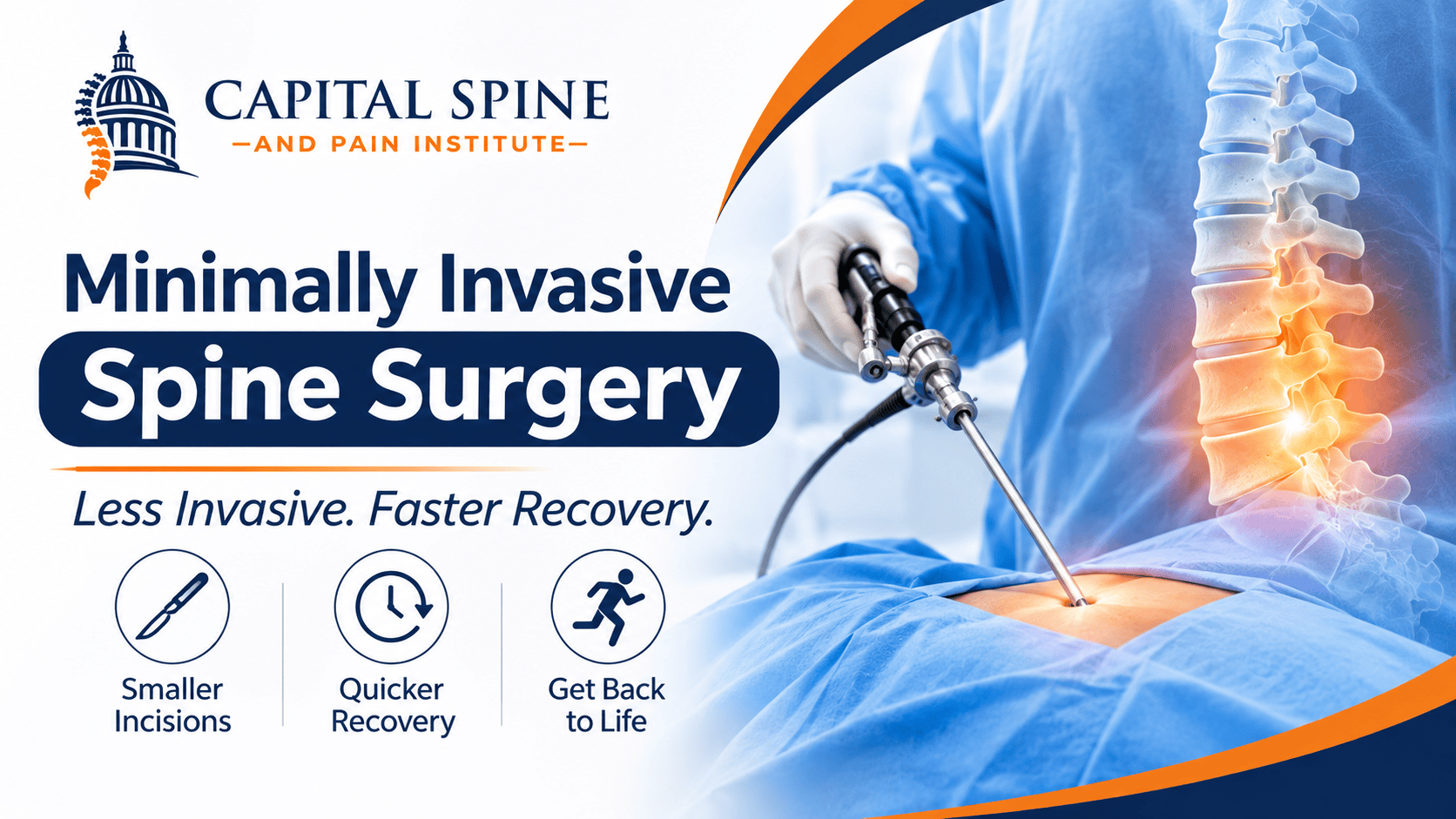
Back or neck pain that spreads into a leg or arm can wear you down. When rest, medication, and therapy stop helping, many people start thinking about surgery and worry about how big the operation will be.
A minimally invasive spine surgeon treats certain spine problems through small incisions, using thin tubes, a camera, and narrow instruments. Not everyone needs surgery, and not everyone who does is a candidate for this approach.
Conditions Treated With Minimally Invasive Spine Surgery
Minimally invasive spine surgery may be an option for:
- Herniated or bulging discs that press on a nerve. Our page on herniated disc treatment explains the non-surgical options that usually come first.
- Lumbar spinal stenosis, where the spinal canal narrows
- Degenerative disc disease, when worn discs lead to nerve irritation or instability
- Spondylolisthesis, where one vertebra slips forward over the one below
Whether surgery makes sense depends on your diagnosis, exam, and imaging. A bad-looking scan does not always explain the pain.
Common Minimally Invasive Spine Procedures
These minimally invasive spine procedures solve different problems, and none fits every patient.
1. Microdiscectomy. The surgeon removes the part of a herniated disc pressing on a nerve. It is the most common herniated disc surgery, usually considered for leg pain that has not improved with other care.
2. Minimally invasive lumbar decompression. The surgeon trims bone or thickened tissue crowding a nerve. This minimally invasive spinal decompression is often part of spinal stenosis treatment.
3. Minimally invasive spinal fusion. Two or more vertebrae are joined so they heal into one solid piece of bone. It may be suggested when a segment is unstable, as with spondylolisthesis, and it heals more slowly than decompression.
4. Endoscopic spine surgery. The surgeon works through a very small opening with a tiny camera. It may be used for selected disc and stenosis problems.
Benefits of Minimally Invasive Spine Surgery
The minimally invasive spine surgery benefits patients ask about most are:
- Smaller incisions
- Less disruption to nearby muscles, in the right procedures
- Less blood loss in selected cases
- A shorter hospital stay and faster return to activity for some people
Results vary with the procedure and your health. Every surgery also carries risks, including infection, bleeding, nerve injury, a spinal fluid leak, and anesthesia reactions. Some patients need another operation later, and surgery does not always remove every symptom. Larger spinal curves usually need a different approach, such as spinal deformity surgery.
When Should You Consult a Minimally Invasive Spine Surgeon?
Consider an evaluation if you have:
- Back or neck pain that won't go away
- Pain shooting into an arm or leg
- Numbness, tingling, or muscle weakness
- Symptoms that have not improved with rest, medication, or therapy
Many people try spine injections and other non-surgical care first.
Go to an emergency room right away if you have new bladder or bowel problems, numbness in the groin or inner thighs, or weakness that is getting worse fast. These can point to serious nerve compression.
How to Choose the Right Spine Surgeon in Virginia
If you have been searching for a minimally invasive spine surgeon near me, ask these questions:
- What training and experience do you have with this procedure?
- Will you review my imaging with me?
- Have non-surgical options been discussed?
- What are the risks and realistic results for me?
- What does recovery look like?
Frequently Asked Questions
What is the difference between a spine surgeon and a minimally invasive spine surgeon?
All spine surgeons operate on the spine. A minimally invasive spine surgeon is also trained in techniques that use smaller openings, and many still perform open surgery when it is the better choice.
Is minimally invasive spine surgery safer than traditional surgery?
Not automatically. Some patients have less blood loss and shorter stays, but safety depends on the condition, the procedure, and your health.
How long does recovery take after minimally invasive spine surgery?
It varies. After a procedure like microdiscectomy, some people go home the same or next day and return to light activity within weeks. Fusion takes longer, often months for the bone to heal.
Who is a good candidate for minimally invasive spine surgery?
Usually someone with a clear cause on imaging that matches their symptoms and who has not improved with non-surgical care. Worsening weakness may prompt surgery sooner.
Schedule a Spine Evaluation in Falls Church, VA
If back or neck pain, numbness, or weakness is getting in the way of daily life, a specialist can help you understand your options. At Capital Spine & Pain Institute, Dr. Avery L. Buchholz and our team evaluate patients across Northern Virginia and explain non-surgical and surgical choices, including minimally invasive spine surgery in Virginia when it fits.
Call Capital Spine & Pain Institute at (571) 399-6340 to schedule an evaluation.
This article is for general education and is not medical advice. It does not replace an exam by a qualified clinician. Treatment depends on your diagnosis and health.


