
Neck pain is something that takes over soon. It does not happen in one go; it comes slowly. Initially, it feels stiff in the morning, followed by a persistent ache, and finally, it becomes numb down one arm or one hand, dropping the coffee cup. At that stage, it’s no longer just pain, but you’re having to adjust your day around it.
In many cases, surgery is the last stop for any issue. If a surgeon is discussing an operation, it is likely that physical therapy, medications, and possibly a round or two of injections have been attempted for months, maybe longer. The subsequent query that the majority of prospective patients ask is that of cervical disc replacement versus ACDF.
In the short version, both surgeries are done from the front of the neck. Furthermore, both are essentially targeted at the same troublemaker, a damaged disc that is pressing on a nerve or the spinal cord. They have different methods to solve that issue, and they're the best. It actually depends on your anatomy, how many spinal levels are involved, and what your MRI or CT scan tells your surgeon as to which one makes sense for you.
Objective of This Blog
Choosing between two surgeries that sound almost identical on paper but are not is genuinely confusing, and that confusion is the whole reason this blog exists. The goal here is not to steer you toward one option over the other. It is to break down what cervical disc replacement and ACDF actually involve, in plain language, so that when you sit down with your surgeon, you can ask sharper questions and understand the answers more quickly. Think of this as the conversation you would want to have before the consultation, not instead of it.
What Is Cervical Disc Replacement?
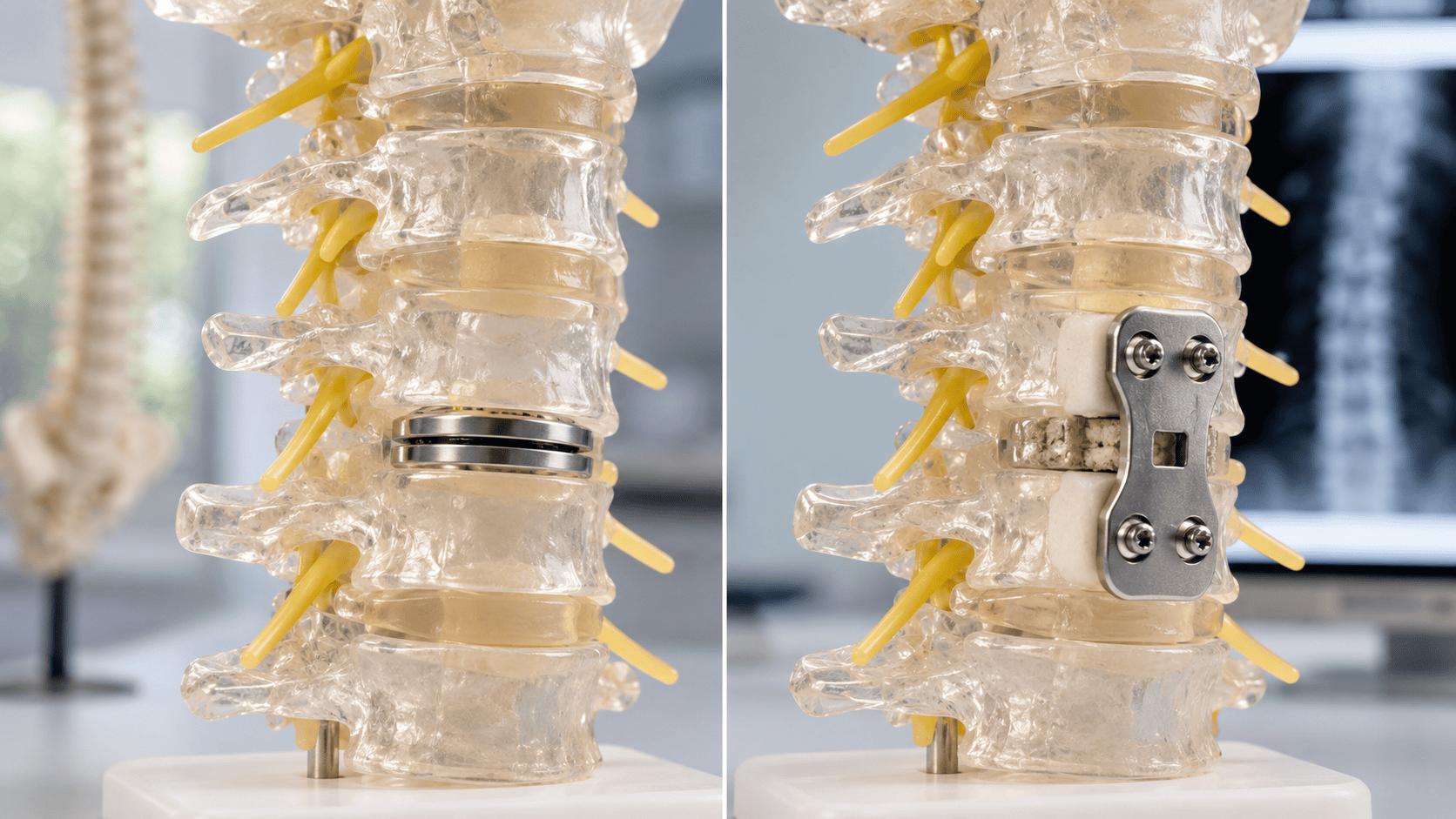
You may also hear this procedure called total disc replacement or cervical arthroplasty, the same operation, different names. The surgeon removes the damaged disc and replaces it with an artificial one, which is designed to move roughly the way a healthy disc would. Instead of locking that section of the neck in place, this approach allows most of the natural bending and turning motion to continue. For patients with single-level disease who do not want to sacrifice range of motion, it has become a genuinely solid, well-researched choice.
What Is ACDF Surgery?
ACDF, short for anterior cervical discectomy and fusion, starts the same way disc replacement does: an incision at the front of the neck, followed by removal of the damaged disc. From there, the two procedures go their separate ways. Rather than an implant, the surgeon fills the now-empty disc space with a bone graft, then typically secures it with a plate and screws. Over the following months, the graft fuses the two vertebrae into a single solid piece of bone, permanently relieving pressure on the nerve. ACDF (anterior cervical discectomy and fusion) has decades of clinical outcomes behind it, which is exactly why it remains the gold standard for a large number of patients.
Conditions Both Surgeries Can Treat
There is quite a bit of overlap here. Cervical radiculopathy (a pinched nerve root), herniated discs, degenerative disc disease, foraminal stenosis, and spinal cord compression can all lead someone toward one of these two surgeries. There is one notable exception, though: when the spinal cord itself is compressed, a condition called myelopathy, surgeons generally lean toward ACDF, since stability takes priority once the spinal cord is involved.
Comparing the Two, Side by Side
| Factor | Disc Replacement | ACDF |
| Goal | Preserve motion | Fuse the segment |
| Implant used | Artificial disc | Bone graft, plate, screws |
| Neck mobility | Mostly preserved | Eliminated at that level |
| Typical recovery | 2–6 weeks | 4-8 weeks |
| Back to desk work | 1–2 weeks | 2-4 weeks |
| Stress on nearby discs | Lower | Higher |
| Best fit | Single-level disease | Multi-level instability, arthritis |
What Each Procedure Does Well
Disc replacement's main advantage is motion. Because the neck keeps moving close to normal, the discs above and below the surgical level do not end up absorbing extra strain the way they otherwise might, and recovery also tends to move a bit faster, since no bone graft has to fuse before you are in the clear.
ACDF, on the other hand, wins on track record. It's been studied for decades, it holds up well long-term, and when arthritis or a spinal deformity is involved, surgeons can address several levels of the spine in a single operation. That flexibility matters more than people expect going in.
Who Tends to Be a Good Candidate for Each
If you're younger, active, dealing with a single level of disease, and your bone density and facet joints are in reasonably good shape with no instability, disc replacement is often a better fit.
ACDF tends to make more sense once things get more complicated: multiple levels involved, real arthritis, spinal instability, osteoporosis, a deformity, or advanced compression of the spinal cord.
What Recovery Actually Looks Like
Honestly, the first week or two feels pretty similar either way: soreness near the incision, some difficulty swallowing or turning your head. Past that early stage, things start to diverge. Disc replacement patients are often cleared for light activity sooner, mainly because there's no graft that needs protecting while it heals. ACDF patients, meanwhile, usually have to steer clear of heavy lifting and twisting for a longer window, sometimes with a soft collar in place while the fusion gradually sets over several months. That said, most people in desk jobs are back at work within two to four weeks, no matter which surgery they had.
Risks Worth Knowing About
Neither surgery is risk-free; no surgery is. Infection, bleeding, a small chance of nerve injury, and some temporary hoarseness or trouble swallowing from the anterior approach are possibilities with both. ACDF carries one extra risk worth flagging: non-union, where the bone graft simply doesn't fuse the way it's supposed to, along with a longer-term chance of adjacent segment disease years down the road. Disc replacement has its own set of implant-specific risks, including things like wear on the device over time or extra bone forming around it. The reassuring part: when the right procedure is matched to the right patient, needing a second revision surgery is genuinely uncommon.
Questions Worth Asking Your Surgeon
- Is my condition better suited to fusion or to preserving motion, and why that one specifically?
- How many levels of my spine are actually involved here?
- What does my imaging and bone density say about my candidacy for each option?
- Realistically, what's the recovery timeline going to look like for my job and my life?
- If this surgery doesn't fully resolve things, what's the next step?
- Are there non-surgical options still worth a shot before we go this route?
Why Choose Capital Spine and Pain Institute
You shouldn't have to guess your way through a decision like this. At Capital Spine and Pain Institute, every evaluation begins with a genuinely thorough look at your imaging and your history, and conservative treatment always gets explored before surgery is ever on the table. If and when surgery is the right call, the plan gets built around your specific anatomy, using minimally invasive procedures wherever they're a good fit for you.
Capital Spine and Pain Institute sees patients at locations in Falls Church, Alexandria, and Richmond, VA, so quality spine care is rarely far from home. To schedule an evaluation with Capital Spine and Pain Institute, call (571) 399-6340.
Bottom Line
At the end of the day, both surgeries are chasing the same goal: relieving pressure on a nerve or the spinal cord; they just take completely different roads to get there. One keeps your neck moving. The other trades some of that motion for long-term stability. Which path is right for you really comes down to your specific anatomy and what your surgeon sees on your imaging. If your symptoms have stuck around this long, the smartest next move is a proper evaluation from a spine specialist who can tell you, with your scans in hand, which surgery actually fits your spine.